
Danbury Criminal Court Cases
Danbury has no municipal criminal court and no “Danbury County” court. Connecticut Superior Court, Judicial District of Danbury and Geographical Area No. 3, operates at 146 White Street. GA 3, also called Part B, primarily handles misdemeanors, motor-vehicle matters, infractions, and Class C, D, and E felonies. The more serious Class A and B felony docket proceeds in Part A through the Judicial District. Both tracks share the building, but they are distinct court assignments.
The chief clerk is the custodian for the Danbury criminal case file. Police reports remain with the agency that created them, and the State’s Attorney makes the charging decision. That is why an allegation in a Danbury Police log may differ from the charge that appears on the court docket. The clerk’s file follows the prosecution as it changes through motions, pleas, trial, judgment, and sentence.
The Division of Criminal Justice court-location page shows how prosecution work is divided at Danbury. Its published view helps distinguish Part A from the GA 3 docket.
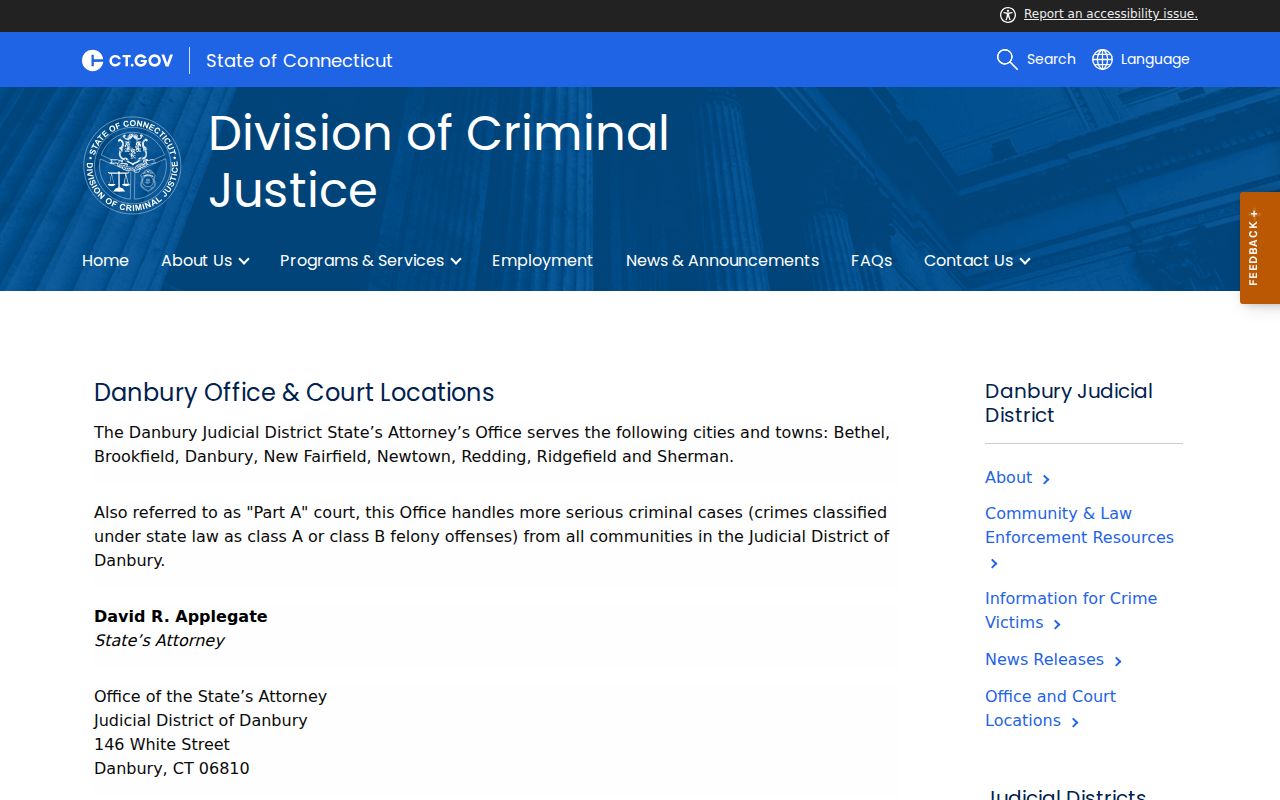
The division is more than a label: it tells a requester which criminal desk and docket path are likely to hold the next event.
Danbury Part A and GA 3
A local case may begin in GA 3 and later transfer to Part A when the filed charge belongs on the serious-felony docket. Selecting Danbury in an online search does not remove the need to read the displayed court location and docket number. Those fields show the current track. “GA” means Geographical Area, while “Part A” identifies the Judicial District’s serious criminal docket.
The Judicial Branch Danbury courthouse page confirms the shared White Street location and public hours. Court hours are 9:00 a.m. to 5:00 p.m., with doors opening at 8:30 a.m. The Chief Clerk Office number is 203-207-8600. Bail Services uses 203-207-8715. One address therefore serves two Danbury criminal docket tracks, a point that prevents needless trips between supposed county or municipal courts that do not exist.
Searching Danbury Case Records
The free Criminal and Motor Vehicle Case Look-up is the first public channel. It offers separate routes for pending matters, convictions, docket numbers, daily dockets, attorneys, warrants, sentence review, and sealing motions. A person checking both active and finished Danbury criminal court cases should not stop after searching only the convictions screen.
- Open the Judicial Branch criminal lookup menu and choose the view that matches a pending case, conviction, docket, or hearing.
- Search by defendant details, or use the docket-number route when the exact number is known.
- Select “Danbury Geographical Area 3 and Judicial District” to narrow a statewide name result to the local court.
- Record the docket, court location, charge, status, disposition, and event date before contacting the clerk.
- Ask the clerk or Records Center for a named document, certified copy, or older disposed file when the web summary is insufficient.
| Field | Input | Required | Use |
|---|---|---|---|
| Last name | Text | Yes for name search | Supports exact, begins-with, or sounds-like matching |
| First name | Text | No | Narrows people with a shared surname |
| Birth year range | Year fields | No | Helps separate similar names |
| Category | Criminal or motor vehicle | Yes | Selects the relevant docket group |
| Court location | Dropdown | No | Use the combined Danbury GA 3 and Judicial District option |
| Docket number | Text | Route-specific | Best identifier once known |
The official lookup menu illustrates these purpose-specific routes rather than a single all-purpose search.
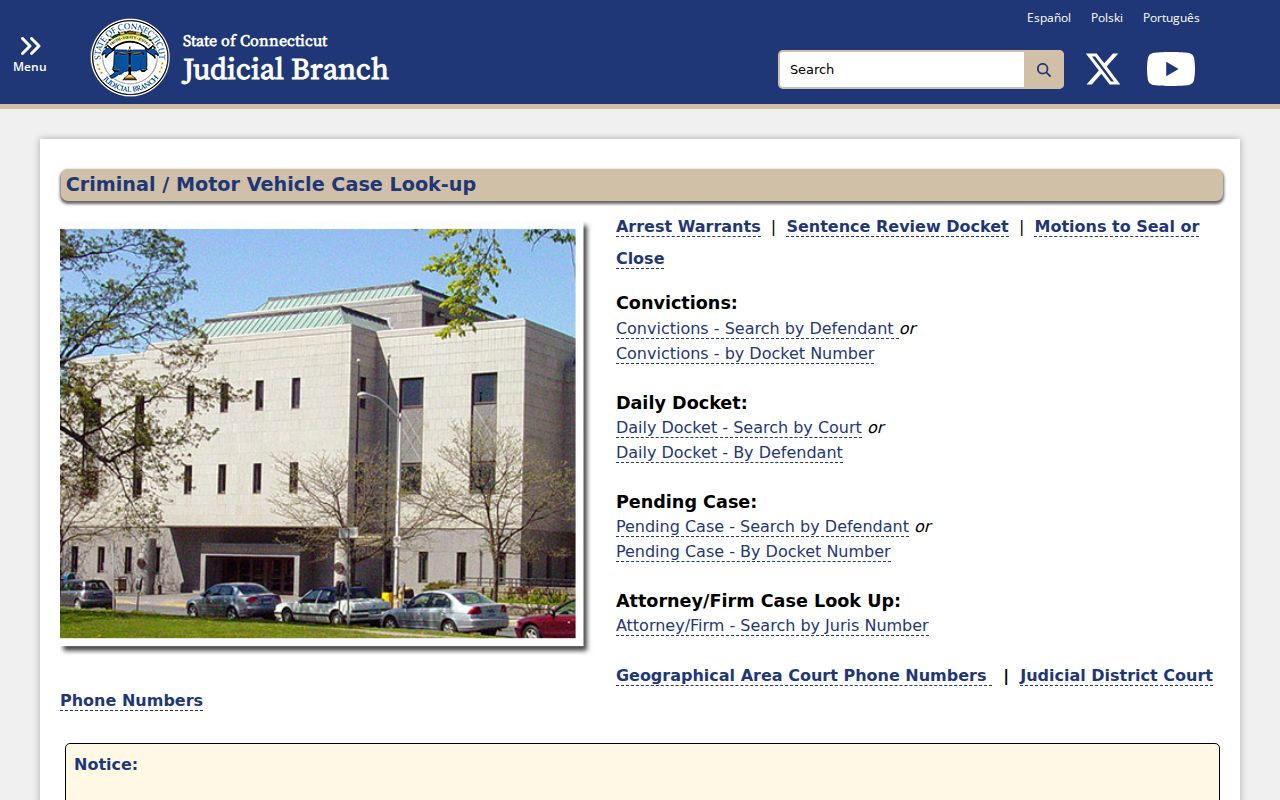
Choosing the right route answers a more precise question and reduces the chance of treating an empty conviction result as proof that no pending case exists.
Danbury Court Website Limits
Online case information reflects entries available through the close of the prior business day. It is not real-time and is not a certified court record. The conviction view generally displays convictions from the last ten years. That is a website publication limit, not a rule that older criminal records are automatically erased after ten years.
An absent result can also follow from spelling, the selected birth-year range, the wrong court location, a reporting delay, or a legal restriction. Juvenile matters, Youthful Offender cases, erased records, sealed material, and some minor categories are not public in the same way. A clerk inquiry is the sound fallback when a known Danbury case does not appear.
The convictions-by-defendant form shows the name, range, category, and Danbury location controls used to narrow a result.
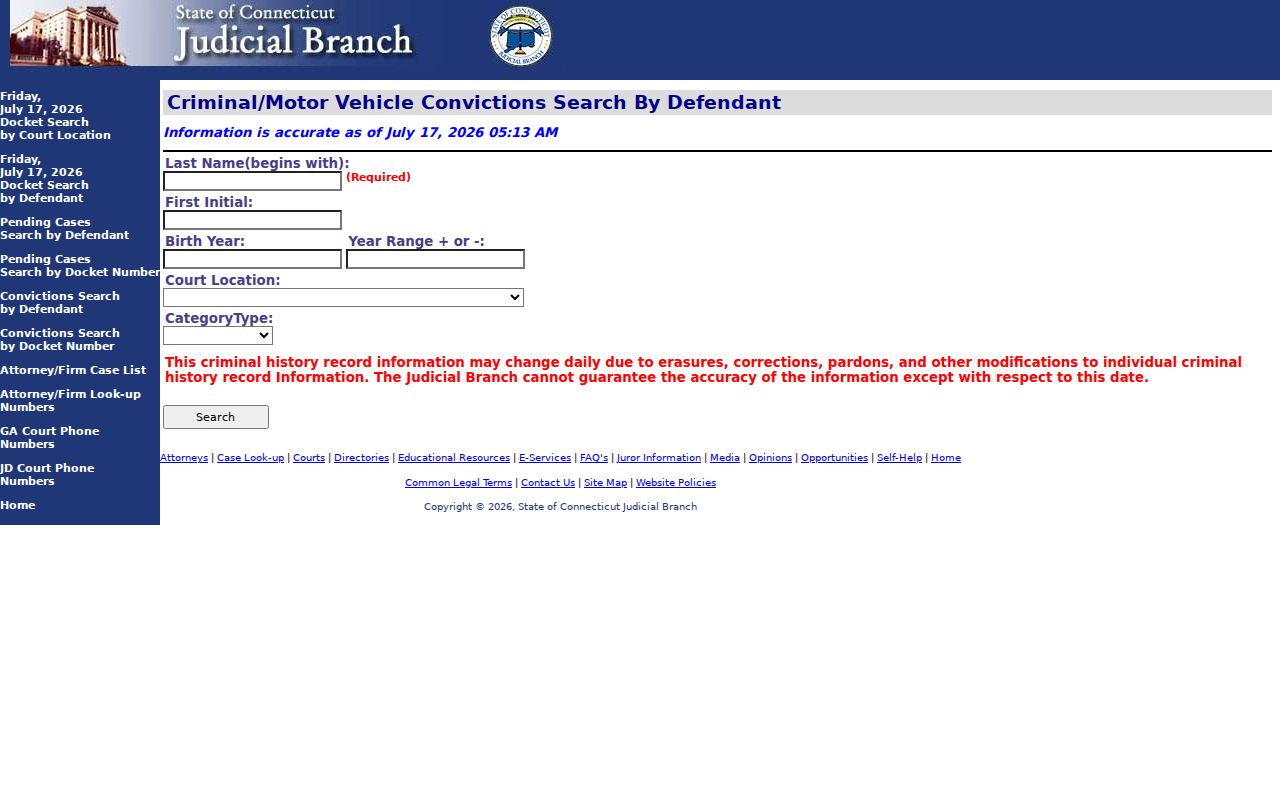
Its fields are useful search aids, but the screen should not be treated as a no-record certificate or a substitute for an official clerk copy.
Inside a Danbury Case File
A Danbury criminal case file documents what prosecutors filed and what the court did. It may include more detail than the public case summary, although access, redaction, and sealing rules still govern particular documents.
| Docket and court | The durable case identifier, current Danbury track, and criminal or motor-vehicle category. |
|---|---|
| Charging instrument | The information or other filing that states the charge pursued in court. |
| Docket entries | A chronology of filings, appearances, motions, orders, pleas, and rulings. |
| Hearing dates | Scheduled or completed court events, with daily-docket information available separately. |
| Disposition | The outcome, such as dismissal, nolle, acquittal, or conviction, which must not be collapsed into one status. |
| Judgment and sentence | The adjudication, sentence date, custody or supervision terms, and related court orders where public. |
Criminal pleadings and exhibits generally are not downloadable like Connecticut civil e-file documents. Once the docket is known, ask for the exact information, judgment, motion, or order rather than requesting every item without a record locator.
Older Danbury Court Files
For a written location-limited search, provide the defendant’s name and date of birth, plus arrest and disposition dates if known. If the arrest occurred outside the eight-town Danbury district, use the proper Geographical Area rather than assuming Danbury holds it. Disposed material may be requested through Centralized Services or at SuperiorCourtRecordsCenter@jud.ct.gov; the published telephone is 860-263-2750.
The current schedule lists $1 per copy page, $2 for certification under seal, $20 for exemplification, $25 for a certified judgment file, and $15 for a noncertified judgment file. A handheld scanner may be used at the clerk counter without a copying fee, subject to access rules. Confirm the needed form and current amount before ordering.
The court-record request guidance explains the fallback for older and offline material.
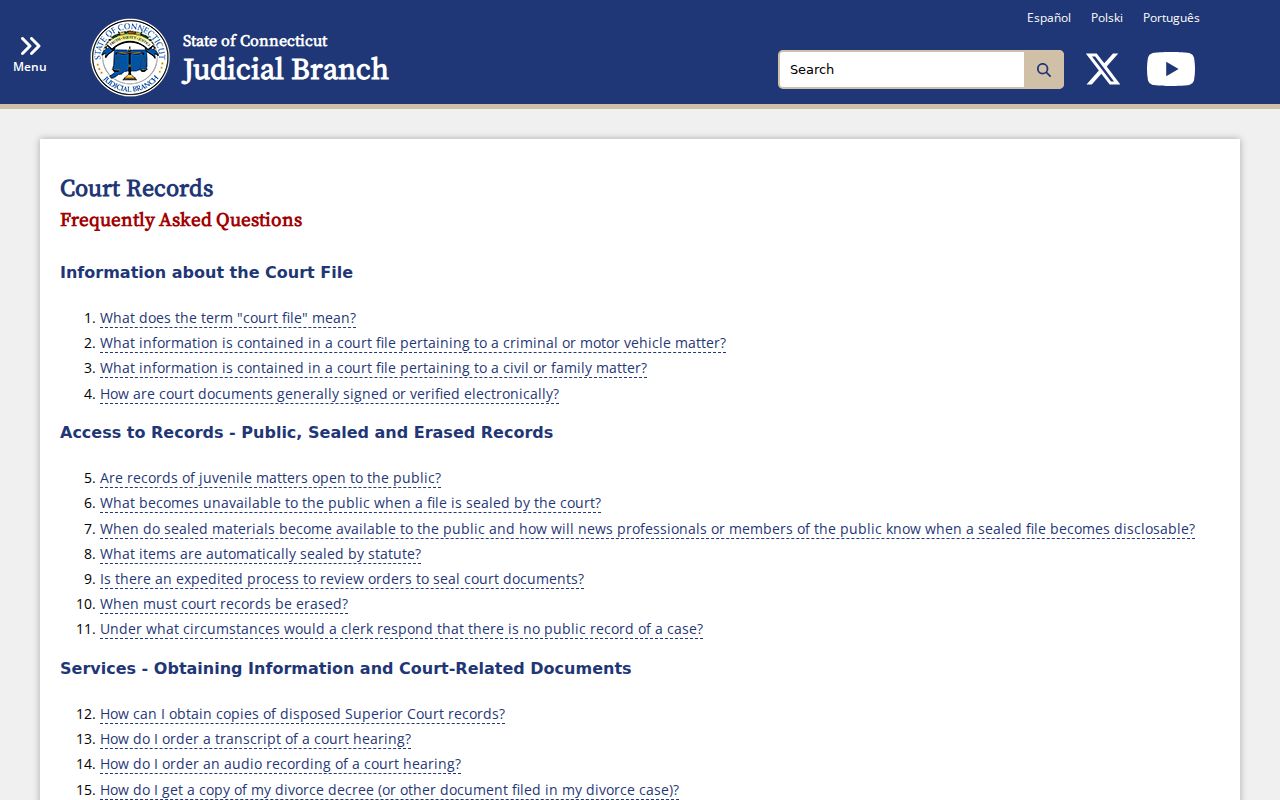
The offline route preserves access when a Danbury docket has aged off a public view or the desired document was never posted online.
How a Criminal Case Moves
The arresting charge is the starting allegation, not a fixed court outcome. The prosecutor may file different or fewer charges. Pretrial motions, negotiations, and rulings may then alter the path before a plea or trial. A final disposition and sentence belong to the court record, while an appeal or sentence-review matter may create another track.
Case flow: Charges Filed › Arraignment › Pretrial › Plea or Trial › Disposition › Sentencing
Useful Danbury docket terms include “nolle,” meaning the prosecutor declines to continue at that time; “disposition,” meaning the outcome; “mittimus,” a custody or commitment order; and “capias,” a court arrest command. A nolle is not a conviction and generally becomes eligible for erasure after the statutory 13-month period.
Danbury Arrest and Filed Charges
Danbury Police records describe what officers alleged when the arrest occurred. The State’s Attorney reviews the matter and decides what to file. A case lookup may therefore show a different statute, fewer counts, or no filed prosecution. For the outcome, use the court docket rather than treating the police log as the final charge list.
That difference also explains why the incident number and court docket serve separate jobs. The incident number locates DPD material; the docket locates the court case. Preserve both when moving between the Records Division and the clerk. The broader Danbury arrest lookup explains the police-created side of that trail.
Danbury Case Access Restrictions
Connecticut FOIA supplies a general public-record rule, but court records also follow Judicial Branch rules and criminal-record statutes. Practice Book Sections 42-49 and 42-49A govern motions and orders to seal criminal files or close proceedings. Connecticut General Statutes Section 54-142a governs erasure after specified acquittals, dismissals, nolles, pardons, decriminalization, and eligible Clean Slate events.
“Not displayed,” “sealed,” “erased,” “confidential,” and “not yet updated” do not mean the same thing. A public docket entry can coexist with a sealed filing, while an erased record is subject to statutory nondisclosure. The clerk can explain access procedure but cannot make a restricted record public merely because a searcher knows the docket number.
Federal Cases Near Danbury
Federal criminal cases do not appear in Connecticut’s state lookup. The nearest federal clerk seat is the U.S. District Court for the District of Connecticut at the Brien McMahon Federal Building, 915 Lafayette Boulevard in Bridgeport. Its public telephone is 203-579-5861, and published counter hours are weekdays from 9:00 a.m. to 4:00 p.m.
PACER is the official federal docket and document channel. Electronic access is generally charged at $0.10 per page with a $3 document cap, and quarterly fees of $30 or less are waived; verify current terms before use.
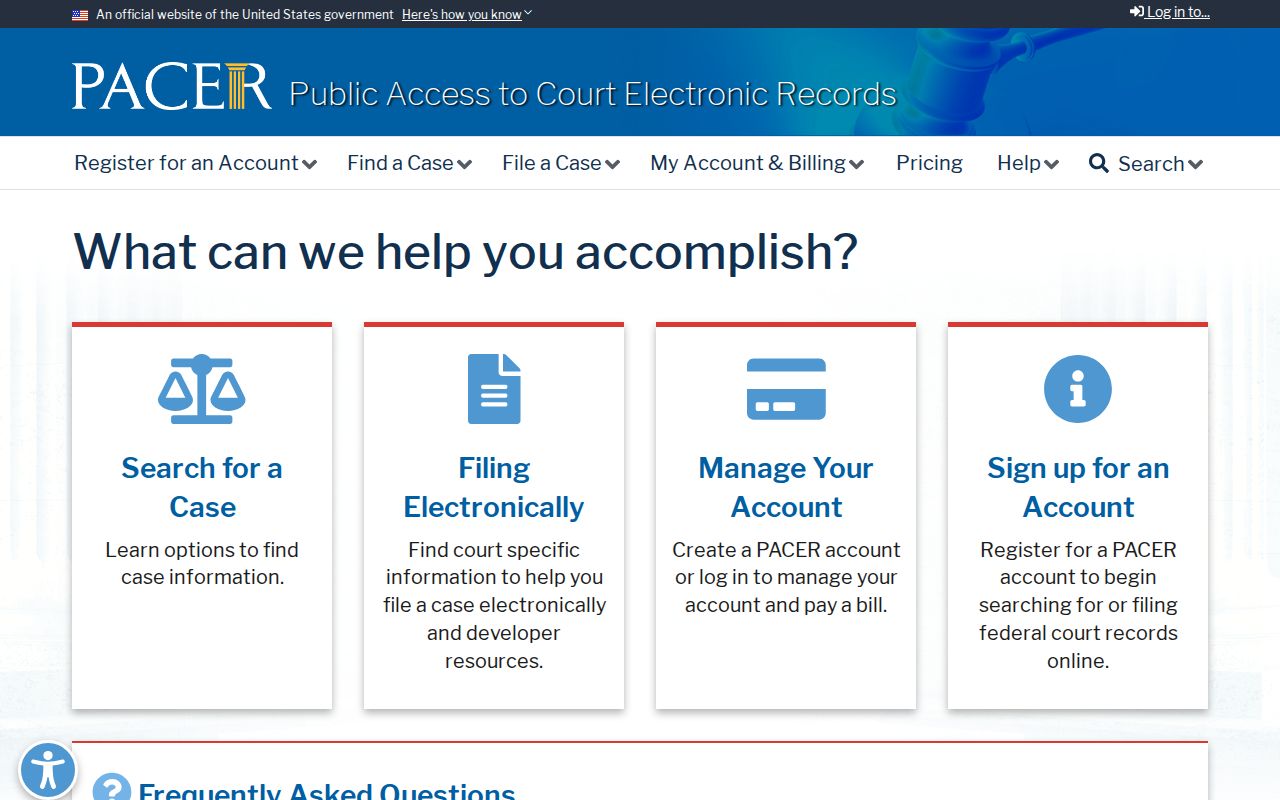
PACER separates the federal layer from Danbury Superior Court records and avoids searching a state portal for a federal prosecution.
The Bridgeport federal courthouse page provides the official local clerk details.
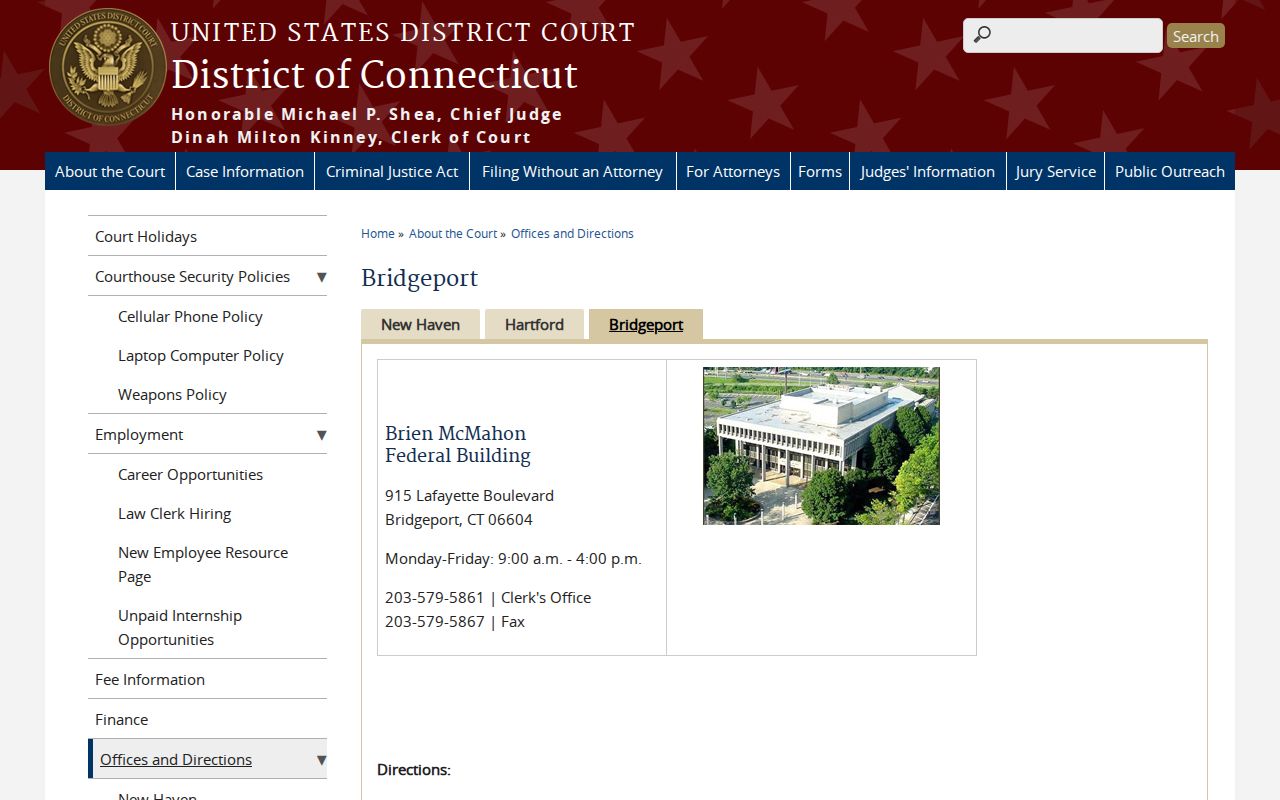
The clerk counter is the authoritative offline option when a federal docket or document needs direct confirmation.