
Sex Offender Checks in Danbury
Begin with the Connecticut State Police public-services page. It links to the Connecticut Sex Offender Registry and its free notification service. Connecticut uses one state registry, so there is no separate Danbury list to reconcile and no county sheriff registry office. DESPP is the authoritative source for a Connecticut entry. The Danbury Police Department remains the local contact when someone suspects a registration violation, but police do not administer the registry.
The official CT.gov service entry is the safe starting point for the state registry and alert link.
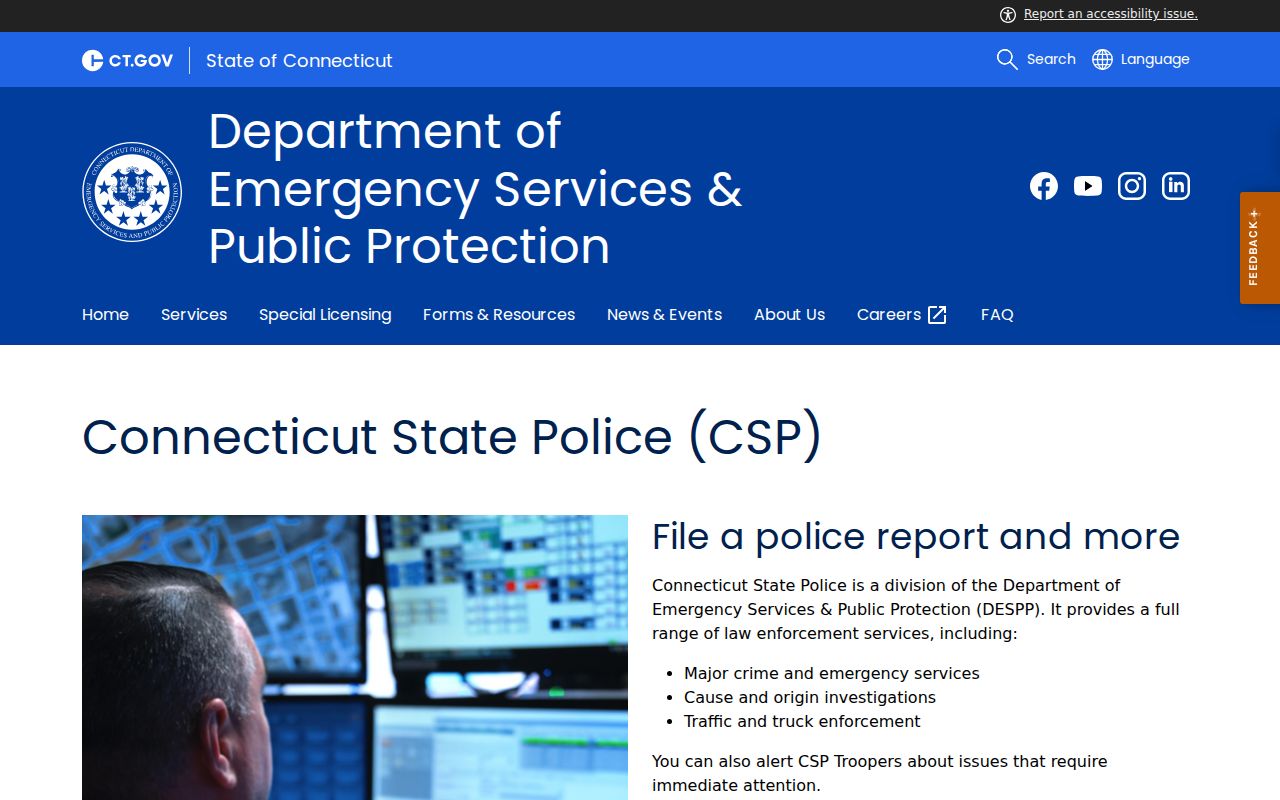
Following that state page helps avoid unofficial copies and confirms that Connecticut State Police, rather than a Danbury county office, administers the system.
Choose a search method that matches the question. A name or alias search helps distinguish a known person. City, ZIP, and geographic-radius searches support neighborhood awareness. Have the spelling, alias, or precise place ready before starting. The vendor portal blocked automated inspection during research, so exact live buttons, radius choices, sorting controls, and pagination are intentionally not described here. Verified statutory search dimensions are shown below.
Danbury Uses a State Registry
Connecticut's structure matters. DESPP, through the Connecticut State Police, receives and publishes the registration data required by state law. Danbury has no county government registry operation and no sheriff registration counter. A searcher who expects a county map may otherwise look for an office that does not exist. The correct public path goes from CT.gov to OffenderWatch.
Danbury Police can receive a report about suspected noncompliance. Its nonemergency number is 203-797-4611. Use 911 only for an emergency, not for a routine registry question. A suspected violation should be reported rather than investigated through confrontation or surveillance.
Note: A Danbury address in a profile is registry information, not a guarantee that the person is physically present when the search is run.
How to Search Connecticut's Registry
The Connecticut Sex Offender Registry is reached through the official state service page. Read the portal's current disclaimer before using its controls. Search narrowly first, compare aliases and identifying details, and then open the full official profile. Because the live portal resisted automated inspection, this walkthrough does not assume interface wording that the research could not verify.
- Open the registry from the CT.gov State Police page and read the current conditions of use.
- Enter a registrant name or alias, or choose a verified place field such as Danbury, a ZIP code, or a geographic radius.
- Compare the returned identity details carefully. Do not match a person on a similar name alone.
- Open the official profile and read the offense summary, address language, registration term, and status in context.
| Field Label | Type | Required | Notes |
|---|---|---|---|
| Name | Text | Unspecified | Registrant-name search is required by statute. |
| Alias name | Name search | Unspecified | Alias-name capability is required by statute. |
| City/Town | Location | Optional | Use Danbury for a city-focused result. |
| ZIP code | Location | Optional | State law requires this search dimension. |
| Geographic radius | Location/radius | Optional | Exact choices require live portal confirmation. |
| Email alerts | Signup | Optional | CT.gov confirms free notification. |
Danbury Address Email Alerts
A one-time Danbury registry search captures only the data shown at that moment. CT.gov also confirms a free email notification service. Address-proximity alerts are the better official channel for ongoing community awareness because they can notify a subscriber of relevant registry changes without repeated manual searches.
Use an address that fits the place being monitored and follow the current signup prompts linked from the state service page. The research verified the service, but not the vendor's exact signup fields. Avoid guessing at radius options. Check the live form and retain any confirmation email needed to activate the subscription.
Inside a Registry Profile
A Connecticut public profile identifies the registered person and explains the legal basis for publication. State law requires a recent photograph, identifying data, residence information, and an offense summary while withholding the victim's identity and treatment information. Read "last known" or status language exactly as the profile presents it. Do not treat the address as live tracking or the statutory term as a risk score.
| Name and Aliases | Current name plus reported aliases or former names. |
|---|---|
| Photo and Identifiers | Most recent photograph and identifying factors; a new image is required at least every five years. |
| Residence | The current or last-known residence language published by DESPP. |
| Offense Summary | Criminal-history description, written summary, offense statute, and conviction or release context. |
| Registration Term | The registration basis, status, and applicable term rather than a public risk tier. |
| Protected Details | Victim identity and treatment information are withheld. |
Protected Connecticut Registry Details
Public access is not the same as access to every agency field. Under Connecticut's registration statutes, victim identity and treatment information remain protected. The public summary may state the victim's age and sex, but it must not identify the victim. Electronic identifiers are collected for registration purposes, yet public display was not verified and should not be assumed.
The live profile also was not inspected closely enough to promise vehicle, school, employer, tattoo, or scar fields. That restraint prevents details from another state's OffenderWatch setup from being misapplied to Connecticut. Section 54-255 can restrict dissemination in defined cases. A missing public entry may therefore reflect inputs, restricted dissemination, release from duty, or the absence of a qualifying publication requirement.
Connecticut Registration Levels and Requirements
Connecticut does not publish SORNA Tier I, II, and III risk rankings. Its law instead ties registration duration to statutory categories, prior qualifying history, the offense basis, and some court findings. These terms must not be converted into predictions of dangerousness. A registrant generally must act within three days after community release and maintain the information required by DESPP.
| Statutory Category | General Duration | Source |
|---|---|---|
| First qualifying nonviolent sexual offense or offense against a minor | 10 years after community release | CGS §54-251 |
| Prior qualifying conviction or specified §53a-70(a)(2) circumstance | Life | CGS §54-251 |
| Sexually violent offense | Life | CGS §54-252 |
| Felony found committed for a sexual purpose | Court may order 10 years | CGS §54-254 |
| Out-of-state, federal, military, or foreign registrant | Until the originating jurisdiction releases the duty | CGS §54-253 |
Danbury Residency Rule Limits
Connecticut has no blanket statewide rule that places every registrant a set distance from schools or parks. The research also found no official Danbury blanket distance rule. Individual court orders and probation or parole conditions may still restrict where a person lives or goes. Those case-specific terms should not be generalized into a citywide map rule.
This distinction is practical. A registry address near a school does not, by itself, prove noncompliance. Review the official profile, and send a concrete concern to law enforcement. Do not attempt to enforce assumed restrictions personally.
Note: Registration duties and individualized supervision conditions are different legal controls, even when both affect the same person.
NSOPW Extends a Danbury Search
The U.S. Department of Justice's National Sex Offender Public Website searches participating official jurisdictions. It is useful near Connecticut's state lines or when a person may have a registration record elsewhere. NSOPW supplements the Connecticut registry. It does not replace DESPP as the source for the current Connecticut entry.
The national search also helps when geography is uncertain. Run the identified name across participating registries, then follow a result to its originating jurisdiction for the controlling profile and its terms. Differences in public fields or categories can reflect different state laws rather than an error.
The official NSOPW search interface is shown in the Department of Justice national portal.
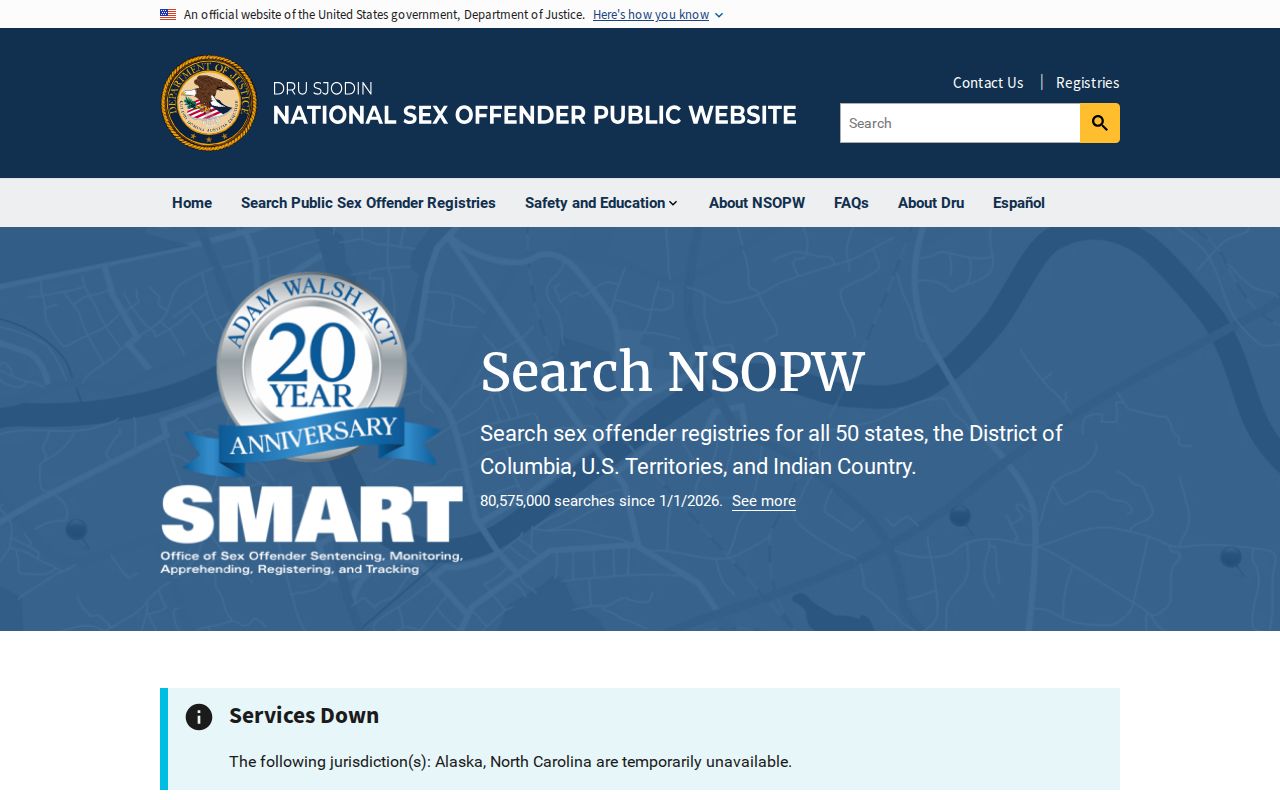
Use that cross-state layer when a Danbury-focused Connecticut search cannot answer where another jurisdiction maintains the registration record.
Report Danbury Registry Noncompliance
Failure to register can be a Class D felony under Connecticut law, subject to the statute's precise elements and timing rules. A person who sees a concrete discrepancy should preserve the public profile details and contact Danbury Police at 203-797-4611 or DESPP/Connecticut State Police. Use 911 when there is an immediate emergency.
Reporting is not proof. Address data can change after relocation, verification, correction, release from a registration duty, or a court restriction. Give the agency facts such as the profile, date viewed, and observed issue. Let trained officials determine whether the information reflects a violation, a reporting lag, or a lawful change.
Community Notification and Lawful Use
The registry supports public awareness and personal or family safety planning. DESPP expressly does not assess every listed person's risk of reoffense or current dangerousness. Use a result to understand the published registration information, subscribe to official notice, and report a genuine concern. Never use it to confront, threaten, follow, injure, or organize harassment against a listed person or anyone else.
Misuse can lead to prosecution: CGS §54-258a warns that any person who uses registry information to injure, harass, or commit a criminal act against a listed person or anyone else is subject to criminal prosecution.